
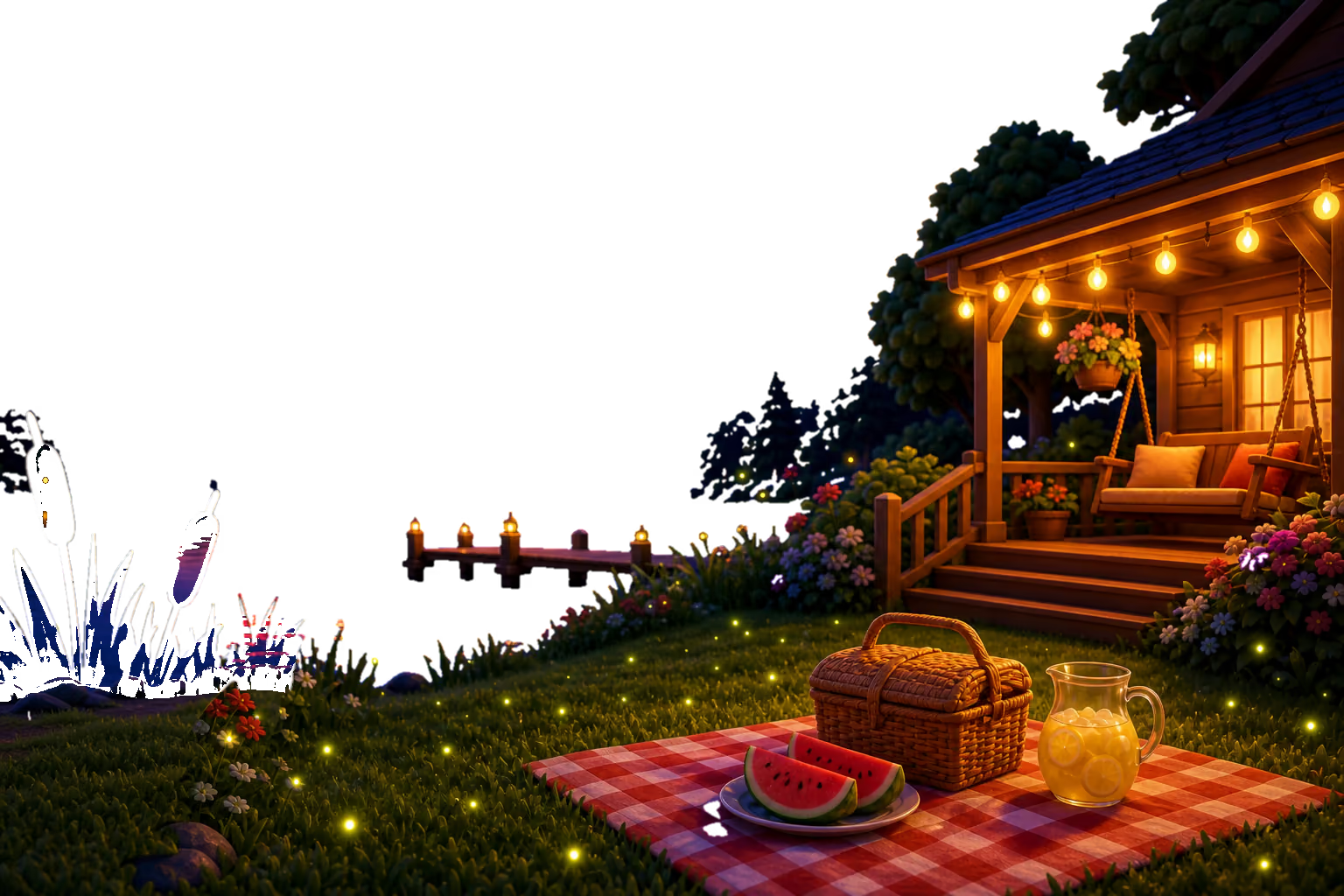


Long solstice evenings
Around the June solstice the Sun takes its longest path across the sky, giving the Northern Hemisphere its most daylight of the year, and the latest, slowest dusks.
Source: britannica.com
Fourth of July 2027
When the fireflies start blinking together.
Long evenings, Fourth of July sparkle and fireflies that can learn to flash in sync.
The story
At the June solstice the Sun reaches its farthest point north, standing straight overhead at noon along the Tropic of Cancer. North of the Arctic Circle it doesn't set at all that day, and at the North Pole it stays up all summer long. For everyone in the Northern Hemisphere it is the day with the most daylight of the year. In 2026 the solstice fell on June 21 at 08:24 UTC.
Long evenings are made for staying out after dark, and in a few eastern US forests the dark brings something extraordinary. In Great Smoky Mountains National Park, around 9:30 on late-spring nights, Photinus carolinus fireflies flash a burst of light together, then all go dark at once, then flash again. No firefly is in charge; each one simply nudges its rhythm toward the flashes it sees.
In the United States, July 4 is Independence Day. Congress voted for independence on July 2, 1776, and John Adams predicted that day would be celebrated “with pomp and parade… bonfires and illuminations.” But Congress approved the Declaration's final wording on July 4, and that is the date that stuck. A year later Philadelphia celebrated with bells, cannon and fireworks that began and ended with thirteen rockets, one for each state. July 4, 2026 marked 250 years since 1776.
Sources: britannica.com: Tropic of Cancer, nesdis.noaa.gov, noaa.gov, timeanddate.com, nps.gov: fireflies, biorxiv.org, archives.gov: declaration of independence, archives.gov: nr05 83, nps.gov: history of independence day, britannica.com: why do americans celebrate independence day with fireworks
On the Arctic Circle, the Sun does not set on the day of the June solstice.
Source: nesdis.noaa.gov
At the North Pole the Sun stays above the horizon all summer and is highest in the sky at the June solstice.
Source: noaa.gov
The solstice is a moment, not just a day: in 2026 it came at 08:24 UTC on June 21, and in 2028 it arrives on June 20 at 20:02 UTC.
Source: timeanddate.com
Great Smoky Mountains National Park is home to 19 species of fireflies; only one there, Photinus carolinus, is famous for flashing in sync.
Source: nps.gov
Photinus carolinus males flash a burst of about 5–8 flashes together, then the forest goes dark for roughly 6–9 seconds before the next burst. Females answer from the ground during the dark pause.
Source: nps.gov
Synchronous fireflies usually start flashing once the forest is completely dark, around 9:30 pm.
Source: nps.gov
In lab tests, synchronized flashing didn't appear until about 15 male fireflies were together.
Source: smithsonianmag.com
The leading idea for why fireflies sync: it helps females recognize their own species in a cluttered, blinking forest.
Source: smithsonianmag.com
At Congaree National Park, Photuris frontalis fireflies flash once every 0.6 to 1.0 seconds, faster when it's warmer.
Source: nps.gov
Most delegates signed the Declaration of Independence on August 2, 1776, not July 4.
Source: prologue.blogs.archives.gov
Around the June solstice the Sun takes its longest path across the sky, giving the Northern Hemisphere its most daylight of the year, and the latest, slowest dusks.
Source: britannica.com
Each late spring, visitors gather near Elkmont in Great Smoky Mountains National Park to watch the synchronous fireflies. The park runs a lottery for the viewing event to protect the fireflies and the forest; the 2026 event ran May 20–27.
Source: nps.gov
Fireworks have been part of Independence Day since the first organized celebrations in 1777, when Philadelphia's display opened and closed with thirteen rockets.
Source: britannica.com
John Adams hoped the anniversary would be marked with “pomp and parade… guns, bells, bonfires and illuminations”, and it largely has been.
Source: archives.gov
Nudge a dusky meadow of fireflies until they all flash together, then send ripples across it.
Take it home · Make it in your photo
2 free creations to start · Then use credits · Browsing is always free
THE MISCHIEF MENU
Every episode is always here.
No FOMO. Just funny little guys.
2 episodes · Save your favorites on this browser

