
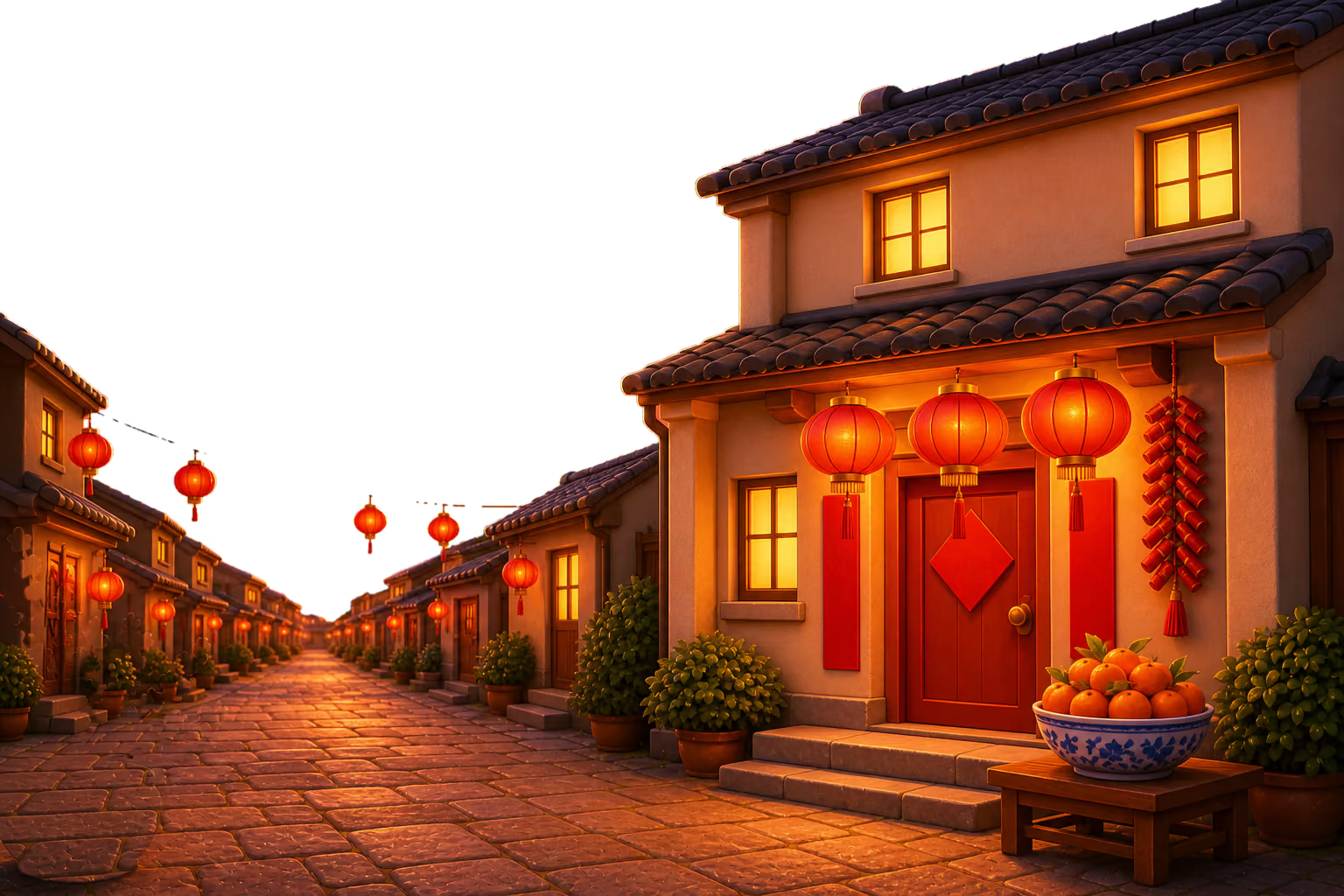



Reunion dinner
Families gather on New Year's Eve for a large reunion meal — often the most important dinner of the whole year, worth traveling a long way home for.
Source: britannica.com
Lunar New Year 2027 · Year of the Goat
Fifteen days of lanterns and luck.
Family reunions, red envelopes and the Great Race of the twelve zodiac animals, ending with the Lantern Festival.
Celebrated alongside New Year’s
A tiny world · made in Blender
Diorama
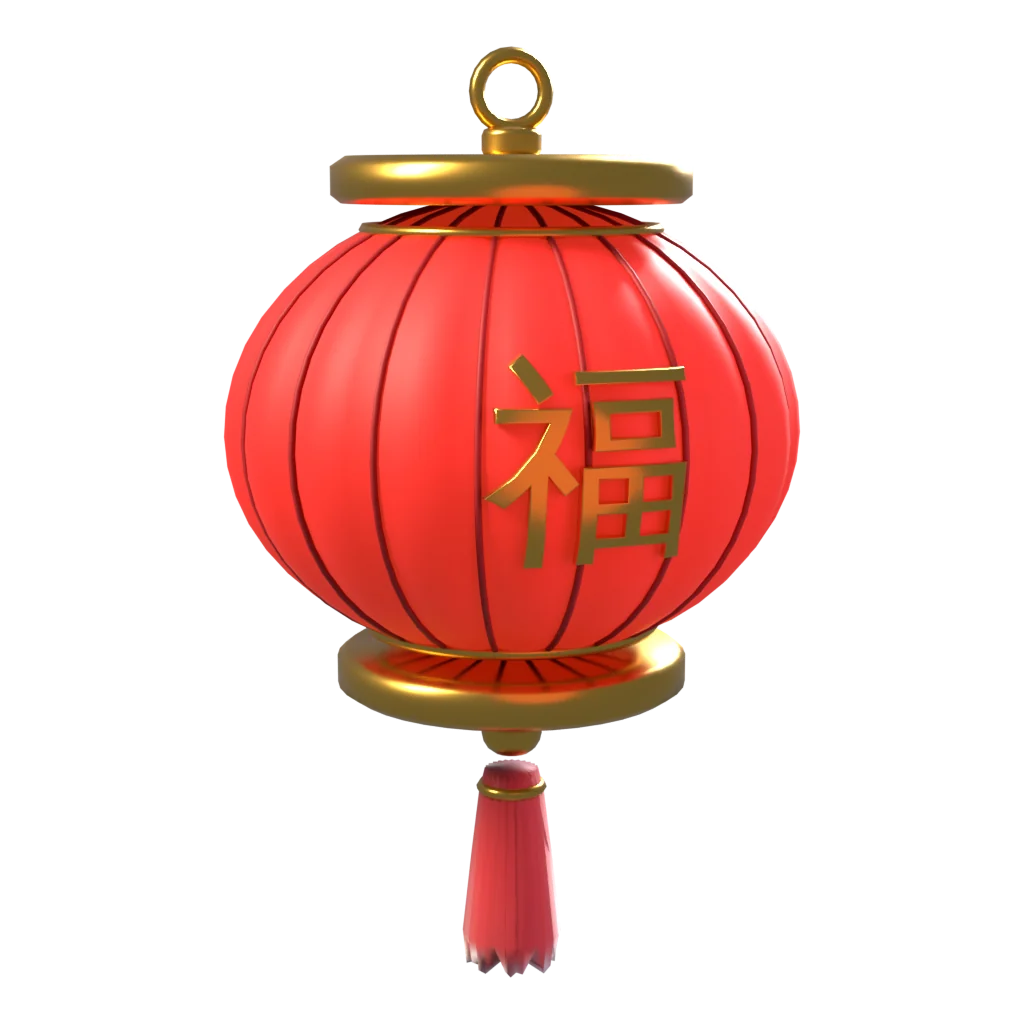
A red ribbed paper lantern with gold caps and a silk tassel that sways in the breeze.
In China, on the 15th day, the Lantern Festival, colourful lanterns are lit and families eat tangyuan, sweet glutinous rice balls. britannica.com
Step inside to turn it.
The story
Lunar New Year is the biggest holiday of the year for many families in China, Korea, Vietnam and Chinese communities around the world. It has many names — Spring Festival or Chinese New Year in China, Seollal in Korea, Tết in Vietnam — and it begins on the new moon that falls between January 21 and February 20. Families travel long distances to share a reunion dinner on New Year's Eve, and older relatives give children gifts of lucky money — in red envelopes in China and Vietnam, and in Korea after a deep New Year's bow called sebae. In China, celebrations traditionally last fifteen days, ending with the Lantern Festival.
An old Chinese legend says a beast called Nian used to raid villages each new year, until people discovered it was afraid of loud noises, bright lights and the color red — which is why there are firecrackers, lanterns and red decorations everywhere. In China, families paste red paper-cuts called window flowers on their windows, and hang the character 福, “good fortune”, upside down on their doors: in Chinese, “upside down” sounds just like “has arrived”.
Each year is linked to one of twelve animals. A favorite legend says the Jade Emperor held a Great Race across a river to choose them. Clever Rat rode on Ox's back and leapt off at the finish to win, Ox came second, and Pig — who stopped for a snack and a nap — came last. Nobody knows exactly how the animal cycle really began; the race story is a fun way to remember the order: Rat, Ox, Tiger, Rabbit, Dragon, Snake, Horse, Goat, Monkey, Rooster, Dog, Pig.
Sources: britannica.com: Chinese New Year, asiasociety.org: lunar new year around asia, asiasociety.org: heres how families three asian countries welcome lunar new year, korea.net, britannica.com: Tet holiday, britannica.com: Nian legendary beast, en.chinaculture.org: content 368374, en.chinaculture.org: content 506764, sova.si.edu, asia.si.edu, britannica.com: Chinese zodiac
Lunar New Year always falls between January 21 and February 20.
Source: britannica.com
Lunar New Year 2026 (February 17) began the Year of the Horse; in China, Saturday, February 6, 2027 begins the Year of the Goat, and January 26, 2028 the Year of the Monkey.
Source: timeanddate.com
In the Chinese zodiac, 2027 is the Year of the Goat, also called the Sheep or Ram: the animal 羊 can be translated goat, sheep or ram.
Source: britannica.com
In Korea, Seollal falls on February 7, 2027, one day after Spring Festival in China: the new moon that starts the year arrives just before midnight in Beijing but just after midnight in Seoul. Korea's Seollal holiday runs February 6 to 8, 2027.
Source: kasa.go.kr
In Korea, sebaetdon, the New Year's money children receive after their bow, is also called “luck money”: it is symbolic, so only a little is given.
Source: folkency.nfm.go.kr
Yut nori is a family and village game played from early in the new year through Jeongwol Daeboreum, the first full moon. In 2022 Korea named it a national intangible cultural heritage.
Source: korea.net
In Korea, eating a bowl of tteokguk, rice-cake soup, at Seollal is traditionally said to make you a year older.
Source: korea.net
Charye, a memorial service for one's ancestors, is now usually held in Korea only on traditional holidays such as Seollal and Chuseok.
Source: nfm.go.kr
Vietnamese children usually receive red envelopes of lucky money on New Year's Day, Tết.
Source: asiasociety.org
Bánh chưng, a square sticky-rice cake, is a Tết food; in legend the square cake stands for the earth.
Source: britannica.com
Chinese paper-cut was added to UNESCO's Representative List of the Intangible Cultural Heritage of Humanity in 2009.
Source: ich.unesco.org
Spring Festival, the social practices of the Chinese people in celebrating the traditional new year, was added to the same UNESCO list in 2024.
Source: ich.unesco.org
A 1948 album in the Smithsonian, “Window flowers: symbolical silhouettes for the Chinese New Year”, holds 295 cut-outs, mostly of red paper.
Source: sova.si.edu
In Chinese, the word for fish (yú) sounds like the word for “surplus”, so a fish stands for plenty in the year ahead.
Source: asia-archive.si.edu
Zodiac years start at Lunar New Year, so someone born in January or early February belongs to the previous year's animal if their birthday came before Lunar New Year.
Source: timeanddate.com
In the Vietnamese zodiac the Cat replaces the Rabbit; in the Malay zodiac, a mousedeer replaces the Rabbit.
Source: asia.si.edu
Historians don't know how the twelve-animal cycle began; the Great Race is a later story to explain it, and some versions have a banquet instead of a race.
Source: britannica.com
In one version of the zodiac story, a gatekeeper heard “enough” as “dog” and “quite enough” as “pig” — which is why there are twelve animals.
Source: blog.library.si.edu
Families gather on New Year's Eve for a large reunion meal — often the most important dinner of the whole year, worth traveling a long way home for.
Source: britannica.com
In China, older relatives give children small gifts of money in red envelopes — hongbao in Mandarin, lai see in Cantonese.
Source: asiasociety.org
At Spring Festival, many Chinese households paste red paper-cuts on their windows to add to the festive mood. Styles differ: Shaanxi window-cuts are simple and bold, while paper-cuts from southern China are fine and delicate.
Source: en.chinaculture.org
Seollal is one of Korea's biggest holidays: families gather, hold ancestral memorial rites called charye, wear hanbok, play folk games, and share tteokguk, a rice-cake soup.
Source: asiasociety.org
On Seollal, children make a deep New Year's bow, sebae, to the older generation, and receive a little New Year's money, sebaetdon, in return. Then everyone digs into a bowl of tteokguk.
Source: korea.net
Around Seollal, Korean families play yut nori, throwing four wooden sticks to race their pieces round a board. It is the most widely played New Year game in Korea, enjoyed by young and old, at home and with the whole village.
Source: folkency.nfm.go.kr
In Vietnam the new year is called Tết. Its zodiac has a few local differences: a cat, for example, where the Chinese zodiac has a rabbit.
Source: asia.si.edu
For Tết, homes in the north of Vietnam usually display peach blossoms, while homes in the south display yellow ochna blossoms.
Source: vietnam.travel
In China, on the 15th day, colorful lanterns are lit, lion and dragon dances are performed, and families eat tangyuan, sweet glutinous rice balls. It closes the New Year celebrations.
Source: britannica.com
In China, firecrackers, fireworks and lion and dragon dances drive away bad luck and welcome the new year — some communities now skip the firecrackers.
Source: britannica.com
From Seollal in Korea to Tết in Vietnam and Spring Festival in China, Lunar New Year is shared by many cultures.
Source: asiasociety.org
Put the twelve animals of the Great Race in order — and find your own.
Fold red paper, cut and punch a pattern, then unfold a window flower and hang it in the light.
Throw the four yut sticks and race your stones around the board in Korea's Seollal game, against Jingle the elf or a friend.

